

What is NAD+ IV therapy?
NAD+ IV therapy is an intravenous infusion of nicotinamide adenine dinucleotide, a coenzyme found in every living cell. It is given through a small catheter over roughly 60 to 120 minutes, usually in doses between 100 mg and 500 mg. It is not a vitamin drip and it is not a medication that treats a diagnosed condition. It is a single compound, infused slowly, and the slowness is not a scheduling choice, it is the whole reason the session is tolerable.
What does NAD+ actually do in the body?
NAD+ does two separate jobs, and conflating them is where most marketing goes wrong.
The first is redox chemistry. NAD+ and its partner NADH shuttle electrons during the reactions that produce ATP in your mitochondria, the actual chemistry of turning food into usable energy. In this role NAD+ is a carrier, not a fuel: it is recycled continuously and is not used up.
The second is as a substrate that genuinely gets consumed. Three enzyme families eat NAD+ to do their work: the sirtuins (SIRT1 to 7), which act on epigenetic control; the PARPs (PARP1 to 17), which handle DNA repair; and CD38/CD157, involved in immune signalling. Because these consume it, cellular NAD+ can be depleted, and levels have been shown to fall under conditions of increased oxidative damage, such as those that occur during ageing.
That last sentence is the honest version of the claim you usually see. NAD+ declining with oxidative stress is well documented. Whether putting it back through a vein produces a clinical benefit is a separate question, and a much less settled one.

Does NAD+ IV therapy actually work?
Honestly: the biology is solid, the human clinical evidence is thin, and anyone who tells you otherwise is selling. There is very little published research on intravenous NAD+ in people, and what exists is small, short, and mostly not designed to measure whether you feel better.
We think that is worth saying plainly rather than hiding. It is also the reason we price and pace NAD+ the way we do, and why we will tell you if we think a cheaper drip is the better fit.
What did the human NAD+ study actually measure?
The most cited human study is a 2019 pilot that infused 750 mg of NAD+ over six hours in eleven healthy men aged 30 to 55, eight receiving NAD+, three receiving saline. Two findings matter.
First, the pharmacokinetics were not what people assume. Plasma NAD+ showed no measurable change until after the second hour, then rose to roughly 400 percent above baseline by the six-hour endpoint. The infused NAD+ disappeared from circulation rapidly in the first two hours, which the authors read as fast uptake or metabolism rather than a sustained blood level.
Second, and this is the part almost never quoted: the study did not measure energy, fatigue, mood, or any clinical outcome at all. It measured metabolites in plasma and urine. It is a biochemistry paper, not an efficacy trial. Citing it as proof that NAD+ drips make you feel better is a misread of what was done.
Note also the mismatch in scale: that study used 750 mg over six hours. A typical clinic session, ours included, is a fraction of that dose over a fraction of that time. The human pharmacokinetic data does not straightforwardly describe what a 90-minute drip does.
If your question is less “what is it” and more “is it worth my money,” we wrote that up separately: is NAD+ IV therapy worth it?
Why does an NAD+ drip take so long?
Because pushing it faster makes people feel awful, and that is well documented rather than anecdotal. In a tolerability study comparing intravenous NAD+ with nicotinamide riboside, all six participants receiving NAD+ reported moderate to severe abdominal cramping, diarrhoea, nausea, vomiting, increased heart rate, throat pain, congestion, and chest pressure during the infusion. Every symptom resolved immediately when the infusion finished.
Participants controlled their own drip rate according to what they could tolerate, and the NAD+ group averaged 97 minutes to get the same volume in that the comparison group managed in 37. The researchers attributed the reaction to supraphysiologic extracellular NAD+ and its proinflammatory effects, meaning the fix is simply to slow down.
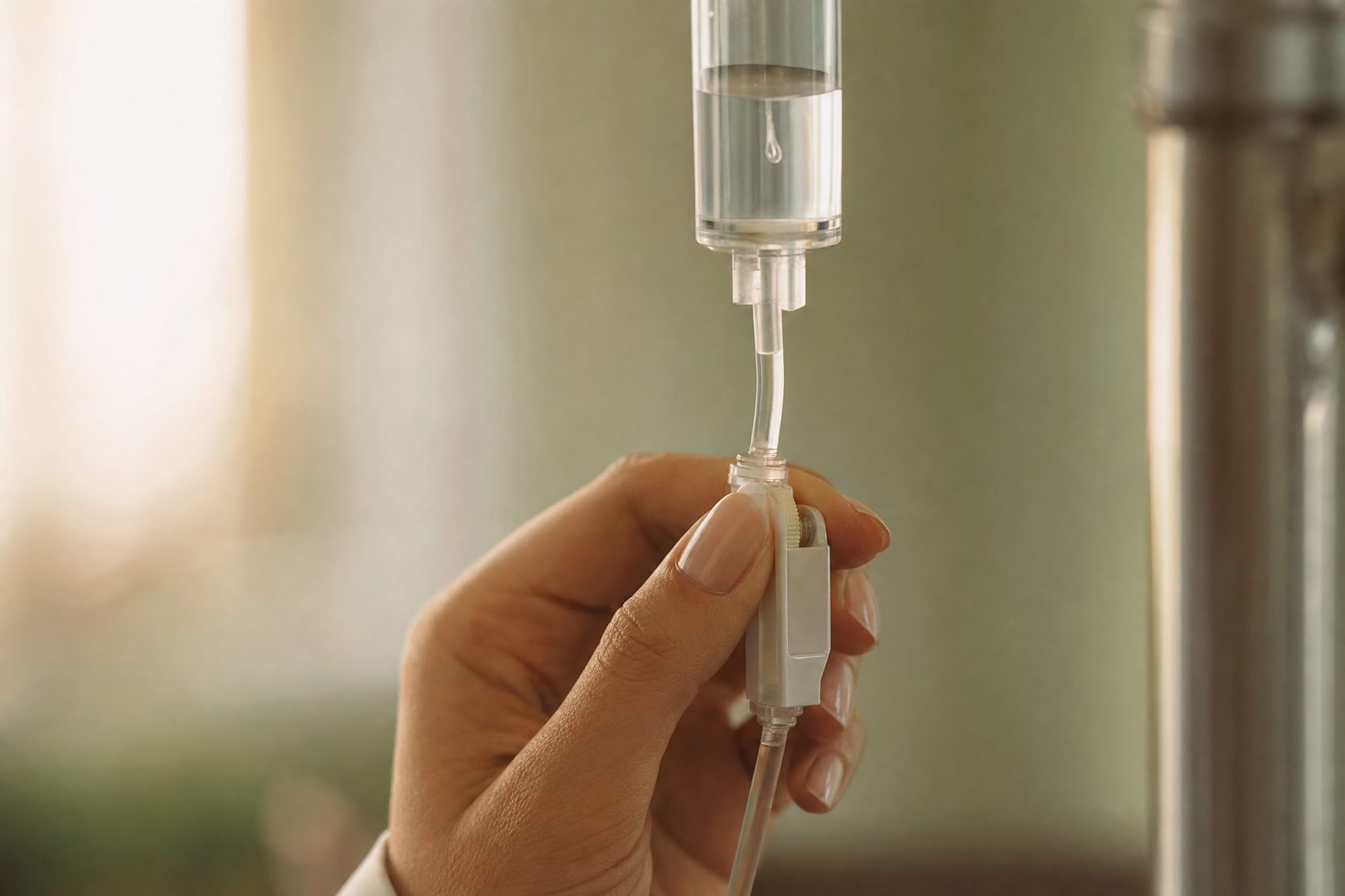
This is why an NAD+ session is paced, why your nurse stays with you, and why the roller clamp gets adjusted rather than left alone. A provider who runs NAD+ fast to free up the chair is not doing you a favour.
What are the side effects of NAD+ IV therapy?
The common ones are infusion-rate related and stop when the drip stops: chest tightness or pressure, abdominal cramping, nausea, flushing, a racing heart, and a strange sensation in the throat. They are uncomfortable rather than dangerous, and they are the reason the bag runs slowly.
Separately, any IV carries the ordinary risks of a needle in a vein, bruising, a small bleed, irritation along the vein, and rarely infection. Those risks are about technique and sterility, not about NAD+ specifically.
What does an NAD+ session feel like?
Most people describe a pressure or fullness in the chest that comes and goes with the rate, sometimes a warm flush, occasionally mild queasiness. It is not painful. Telling your nurse the moment it starts is the correct move, because the answer is almost always to slow the drip for a few minutes and then resume.
Afterwards, reports vary widely. Some clients describe feeling clearer the next day; others notice nothing. We do not promise a specific outcome, because the published evidence does not support promising one.
How much does NAD+ IV therapy cost?
Our NAD+ IV is $799 for a 250 mg infusion running 90 to 120 minutes. NAD+ Boost is $499 for 100 mg over about 60 minutes, which is the sensible way to find out how you respond before committing to a full session or a series. Both are delivered at your home or hotel by a licensed Registered Nurse.
NAD+ is expensive relative to a vitamin drip because the compound itself is expensive and the session occupies a nurse for up to two hours. If cost is the deciding factor, a Myers Cocktail at $349 is a better first experiment than a rushed NAD+ drip.
Does insurance cover NAD+ IV therapy?
No. NAD+ infusions for wellness or longevity purposes are not covered by insurance or Medicare, and are paid out of pocket. NAD+ is not an FDA-approved treatment for ageing, fatigue, or cognitive performance, and we do not present it as one.
How often should you get NAD+?
There is no evidence-based schedule, and anyone quoting one with confidence is improvising. In practice, clients who continue tend to start with a lower dose, see how they respond over a week, and then decide between an occasional single session and a short series. Starting with a series before you know how you tolerate it is the most common way to waste money on this.
Who should not get NAD+ IV therapy?
Skip it, or clear it with your physician first, if you are pregnant or breastfeeding, have significant kidney or liver disease, have a heart rhythm disorder or uncontrolled blood pressure, are undergoing active cancer treatment, or take medication with a narrow therapeutic window. Our nurse screens every client before the first drip and will decline the booking if NAD+ is not appropriate.
Is NAD+ IV better than injections or oral NMN?
They are different trade-offs, not a ranking. An IV bypasses the gut entirely and delivers the full dose to the bloodstream, but it takes one to two hours and costs the most. Subcutaneous injections are far quicker and cheaper but deliver a smaller dose. Oral precursors such as NR and NMN are the cheapest and easiest, and there is more published human research on oral precursors than on NAD+ infusions, the opposite of what the IV industry implies.
If the honest evidence base is what matters most to you, oral precursors are the more defensible starting point. If you want the dose delivered directly and are willing to pay for a nurse’s time, the IV does that.